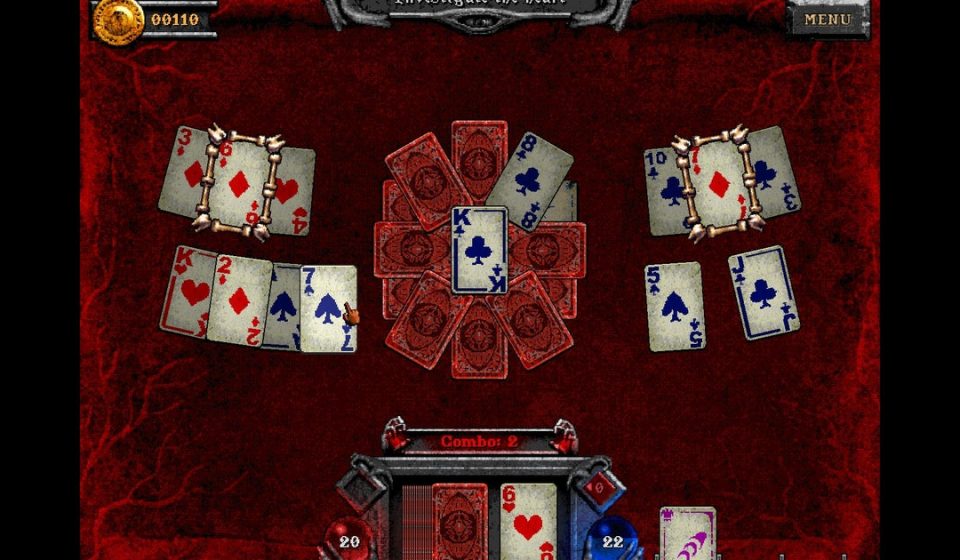

The topic Horror-steeped card game Forbidden Solitaire shows how a strong theme can elevate… is drawing steady attention: readers, analysts, and industry watchers are all tracking how the story may unfold in the days ahead.
This is taking place in a fast-moving context — product cycles, platform shifts, and competitive moves can reshape the outlook quickly, so the details below are worth a careful read.
What follows is a clear walkthrough of the main facts and angles you need to make sense of the news.
Like a tag team of oiled snakes that have entered a wrestling contest, theme is a difficult quality to pin down. A game can be well designed, but if it lacks a coherence between those mechanics and its appearance, narrative, and its framing, there is a dissonance that can be hard to ignore. I realise I’ve just stepped into an old argument by using the word ‘dissonance’, but Hocking was right, games that don’t cohere can be jarring. A developer may desire that sensation of discomfort, but often it is accidental and unwanted.
(Much like opening an article with a simile about wrestling snakes when there is nothing connecting that image to a game about solitaire. It might be a good line, but it doesn’t smoothly connect with the rest of the article to elevate its argument.)
Anyway, what does this all have to do with Forbidden Solitaire, a game in which you’re delving deeper into a dungeon filled with horrors, progressing by clearing screens of cards? Well, it’s an excellent example of how well-handled theming can raise a game into something more than its parts.
I’ve been playing Grey Alien Games’ work since they released Regency Solitaire in 2015, and their games often revolve around the same core, Solitaire-inspired mechanics. Each level is a screen filled with stacks of playing cards, and you must clear the screen by picking cards that are one higher or lower than the one currently in your hand. In addition to standard playing cards, you may find padlock cards which can only be cleared with a matching key card, special cards that reshuffle all the stacks, or ones that change cards into suits or numbers that may help you. Except, in each of their games – Regency Solitaire, Shadowhand, Ancient Enemy, and now Forbidden Solitaire – the scenario for those mechanics changes, and in doing do, they show the power of recontextualising.
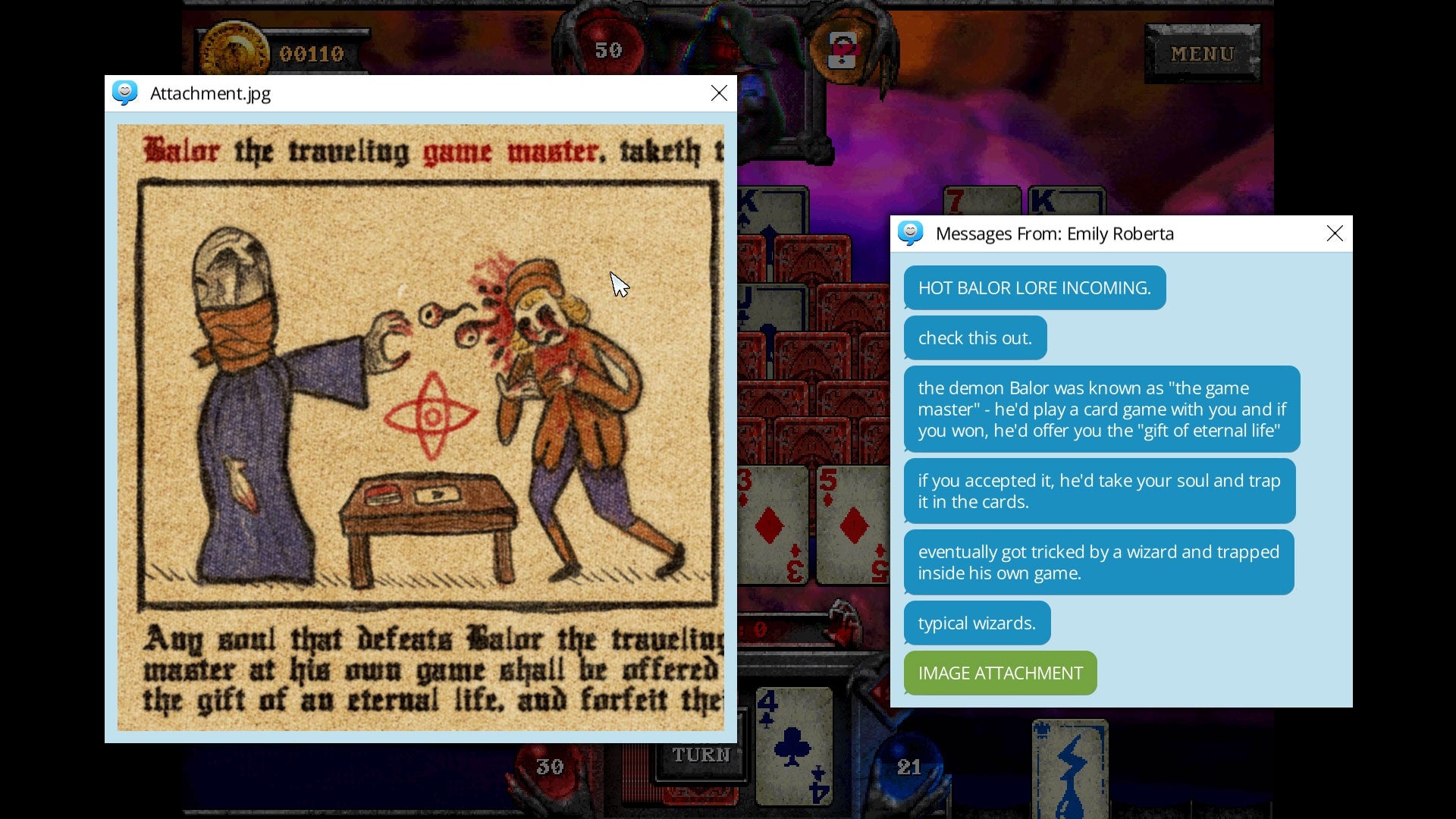
In Forbidden Solitaire, you’re playing a game within a game. Although it’s set in 2019, your character is playing a 1995 CD-ROM they found in a second-hand shop. It’s one you vaguely remember from your childhood, if mainly for the controversy it caused at launch. The game sees you breaking into an old dungeon and exploring its depths. Each locked door that blocks you, labyrinth that puzzles you, or enemy that challenges you is tackled with the mechanics of Grey Alien Games’ previous releases: screens of stacked cards to be cleared. Even familiar special cards, such as the one which shuffles all the cards before you, make a return. As you progress through Forbidden Solitaire’s dungeon, you’re interrupted by messages from your sister in the present, who is researching the game and the controversy surrounding it, sending you links to police reports, old news clips of the secretive developer, and hidden documents on a centuries-old group of cultists.
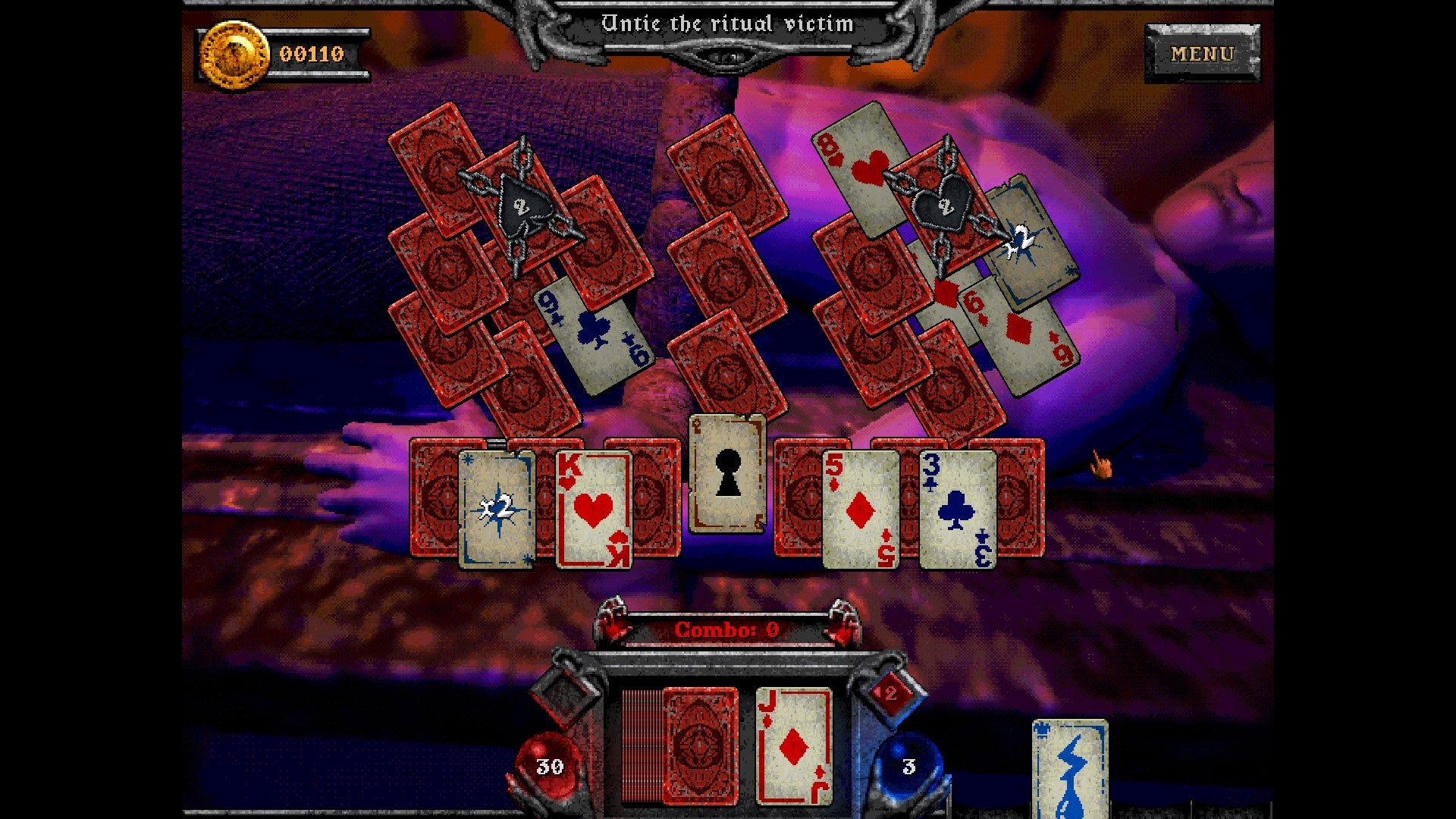
Yet, despite the mechanical familiarity, it’s this fresh theme that elevates Forbidden Solitaire into something special. For new players, the 1995 game framing device immediately gives an allowance for the simple card mechanics, and allows them to sink into the kitsch horror story of cult members developing haunted video games. But, for returning players like me, I can see all the neat ways the old tools have been adapted to fit this new world. When you find a person marked for sacrifice tied to a bed, for instance, the level to free them is filled with locks that only disappear when you match enough cards of the same suit. It’s a pairing of unlocking mechanics that have been in Grey Alien Games’ work for at least the past decade to a moment in the story where you are untying a character. The action dovetails with the narrative perfectly.
Anyway, when I realised the role that theme had to play in Forbidden Solitaire, I was feeling extremely smart and smug. Then I reread Adam (RPS in peace) and Pip’s (RPS in peace) Regency Solitaire verdict from 2015.
Adam: I think the whole game is a superb example of how a decent design can be elevated by a strong theme. It’s not even particularly overindulgent – flourishes throughout but no extended dialogues or huge slabs of exposition. It’s a few attractive backgrounds (though with an inaccurate non-pebbled Brighton beach, I’m told by RPS chatroom stalwart and Brighton denizen Alec Meer), a handful of characters and miniature conversations to set the tone. But it’s all done so well. It seems to be aware of its own posture in a way that allows it to be well-mannered, well-meaning and not at all over-bearing.
If it had been pixies or space marines, I don’t think I’d have been particularly interested at all – and that’s not to say the actual card game isn’t well-constructed because it is – but even though the story is slight, it’s a great reward at the end of a few hands.
Pip: I’d agree with that, particularly about the setting. It’s a game that has a good understanding of its own size, scope and the tone which suits it.
Those absolute cads. Still, go play Forbidden Solitaire anyway. It’s a far better time than trying to get an oiled snake into a three-piece suit.
Sign in and join us on our journey to discover strange and compelling PC games.