
The topic The engine parts that ‘fight the laws of the universe’ is drawing steady attention: readers, analysts, and industry watchers are all tracking how the story may unfold in the days ahead.
This is taking place in a fast-moving context — product cycles, platform shifts, and competitive moves can reshape the outlook quickly, so the details below are worth a careful read.
What follows is a clear walkthrough of the main facts and angles you need to make sense of the news.
Every time you fly, an extraordinary feat of endurance occurs inside the aircraft’s engines.
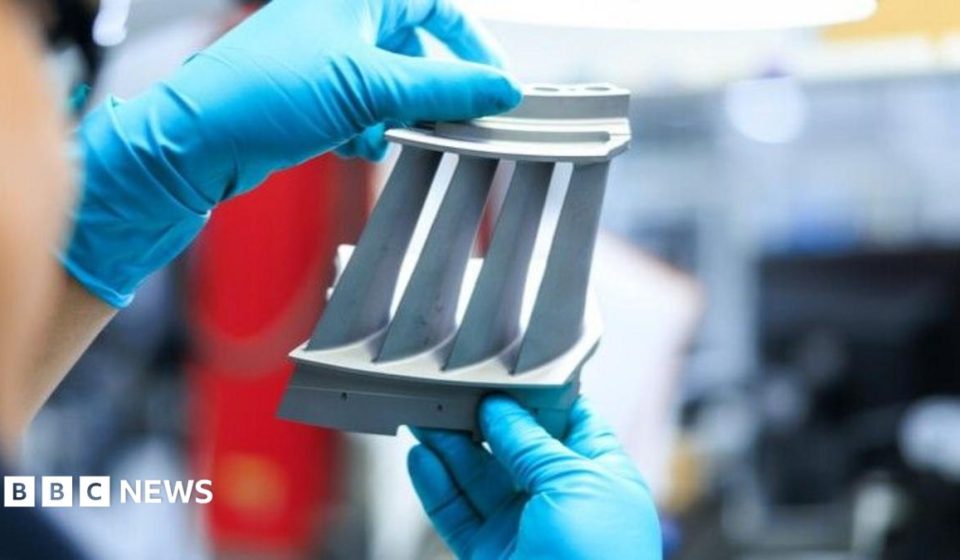
Hidden from view inside the sleek outer nacelle are hundreds of little turbine blades that can shrug off enormous mechanical stresses and temperatures exceeding 1,500C.
It is a true engineering marvel. And these hardy blades are not sculpted or cut from their material – they are grown.
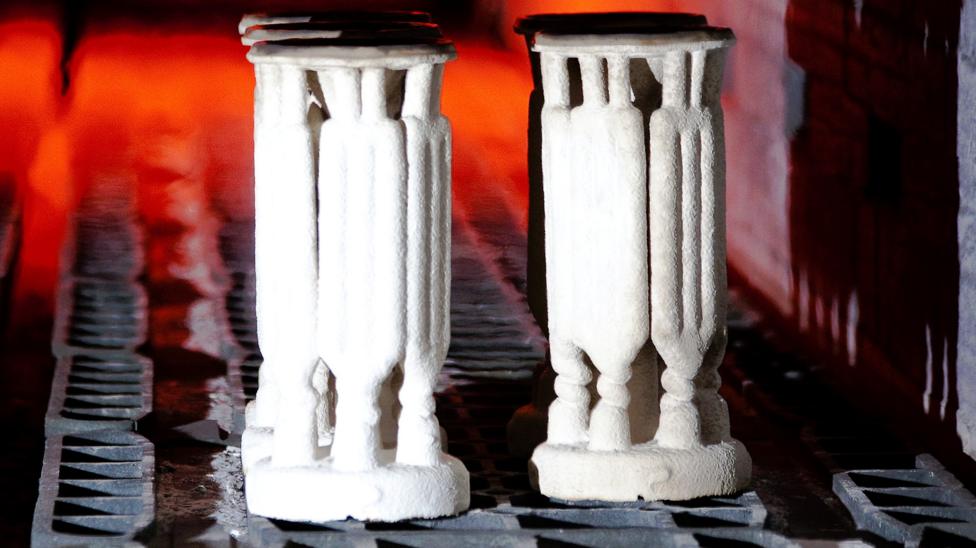
During the 1960s, engineers worked out how to take a molten metal alloy, cast it into the shape of a turbine blade, and then cool it very carefully from one end to the other over a matter of hours. A single crystal or grain of metal alloy forms during this process of gradual, delicate solidification.
Like turning a cup of water into one big snowflake, of your own design, rather than a mini blizzard of many smaller snowflakes.
“It’s about as complicated as manufacturing gets,” says Ben Fifoot, manufacturing engineer at Rolls-Royce, which makes turbine blades in the UK. “It’s a real motivator to get out of bed in the morning.”
Only a handful of companies around the world can produce these single crystal turbine blades, and the process has been perfected end-to-end in just five countries, including the US and UK. Engine-makers continually vie for access to the technologies.
Rolls-Royce, GE and France’s Safran are among the few firms that have perfected the process.
In September, GE Aerospace announced, external it would acquire its turbine blade supplier for $11.75bn (£8.78bn). Neither company responded to BBC News’ requests for comment but the move has been described as an effort to ensure supply of these critical components.
Separately, in March, Rolls-Royce said it would invest more than £19m in its Rotherham blade casting facility.
Turbine blade specialists continue to work on improving the capabilities of this little-known technologies. All the while, China is desperate to prove that its engineers can produce turbine blades of the same quality as those in the West. Who will come out on top?
“Demand for [turbine blades] is huge. So few companies have managed to do it, which does give it this kind of magical aura,” says Bill Sweetman, an aviation industry writer and consultant.
He suspects GE Aerospace’s recent move is about securing reliability and predictability in the notoriously volatile aircraft manufacturing supply chain.
But why is the single crystal casting process, which has been around for decades now, still so specialist?
To grow one of these blades, asserts Fifoot, is to “fight the laws of the universe”.
This is because each molten blade would naturally cool into a solid object consisting of many small grains of metal alloy, all jumbled together. But you don’t want a crumbly sugar cube, you want a perfect diamond.
Getting a single crystal to grow into the shape of the blade instead isn’t just a matter of cooling the molten version down slowly, the process also uses a bizarre trick called a pigtail.
The pigtail is a small spiral at one end of the blade. Fifoot says that, at the beginning of the cooling process, this spiral “chokes” the flow of solidifying crystals so that just one takes over. A bit like a hairpin corner in an F1 race right before the finish line – one driver can take the lead here and go on to win.
“Sometimes we need to play around with the number of turns or the angles on [the pigtail] to try and get more favourable grain,” adds Fifoot. Once the blade is formed, this crucial but sacrificial spiral is cut off.
France’s Safran is among the few companies that can make single crystal blades

Blades made by Rolls-Royce are used in aircraft engines including the Trent XWB-84, which powers the Airbus A350-900, and the Trent 1000 XE, for the Boeing 787.
The single crystal is essential to ensure each blade’s performance. Sometimes a blade doesn’t cool quite as planned, for example two crystals form within it instead of just one, and the metal alloy must be reprocessed so that the manufacturer may re-use the material.
Special ceramic coatings also protect blades from extreme temperatures inside engines. And another important feature is that blades are cast with tiny channels that allow a flow of cooler air to coat them in a kind of film while the aircraft engine is working.
“The drive at the moment [across the industry] is currently to make those cooling passages really intricate,” says Paul Withey, at the University of Birmingham, who formerly worked for Rolls-Royce. The more turbulent those little flows of cool air are, he explains, the more they will knock heat out of the surrounding, much hotter air.
And blade-makers also seek to reduce the mass of these components as much as possible.
“If we can take any weight out of it, you can run that engine more efficiently using less fuel – you can spin it faster and hotter,” says Fifoot.
Meanwhile, China hopes to become only the sixth country to master the whole technologies chain for single crystal blade casting.
A report in May, external quoted one engineer at the AECC Beijing Institute of Aeronautical Materials claiming that China now had a single crystal alloy “superior to or equivalent to the second-generation single-crystal superalloys widely used in Europe and the US”. It costs less to make, too, apparently.
But the West has a “huge advantage” over China given that the majority of commercial airliner production happens there, says Sweetman. Supply chains and the latest innovations are generally clustered in the West. Plus, Western manufacturers also have lengthy safety records under their belts.
China must compete on practically every aspect of aircraft manufacturing, external – by no means just on turbine blades – in order to make serious in-roads. “You can definitely see that happening but it’s a long, uphill struggle,” adds Sweetman.
Demand for aircraft is currently high, which is already straining various supply chains in the industry. That demand could grow higher still, suggests Withey.
During the next few years, one of the two main aircraft manufacturers, Airbus and Boeing, could launch a new short-haul plane, external, he says. Then, the other would have to follow suit in order to remain competitive.
“There’ll be a bun fight,” says Withey, over who gets to supply the engines and, by extension, those all-important single crystal turbine blades.