
The topic Man in his 70s diagnosed with heart defect usually found in infancy is drawing steady attention: readers, analysts, and industry watchers are all tracking how the story may unfold in the days ahead.
This is taking place in a fast-moving context — product cycles, platform shifts, and competitive moves can reshape the outlook quickly, so the details below are worth a careful read.
What follows is a clear walkthrough of the main facts and angles you need to make sense of the news.
Mechanic Carlos Perez felt fine as he finished up work at his car repair shop in June 2025. He sat down with a glass of water, planning to relax for a few minutes before heading home.
Then, out of nowhere, his heart started pounding and his chest ached. When he tried to stand, “the world narrowed,” Perez said.
Perez called his daughter-in-law, a doctor, and she recommended he go to the emergency room. His wife brought him to the hospital. There, doctors determined that he was experiencing atrial fibrillation, or AFib, when the heart beats irregularly. The common condition can be dangerous: If left untreated, it can lead to stroke or heart failure.
Perez’s heart rhythm stabilized after about 90 minutes. But no one could figure out why the irregularity had happened. A battery of tests found no obvious cause. Then an advanced scan looked at both sides of his heart.
“One doctor came in, then two doctors, and then a whole bunch of doctors went into the room,” Perez said. “I’m getting really concerned. And they said, ‘No, no, don’t worry. It’s just that we’ve all read about it, but we’ve never seen a patient with this.'”
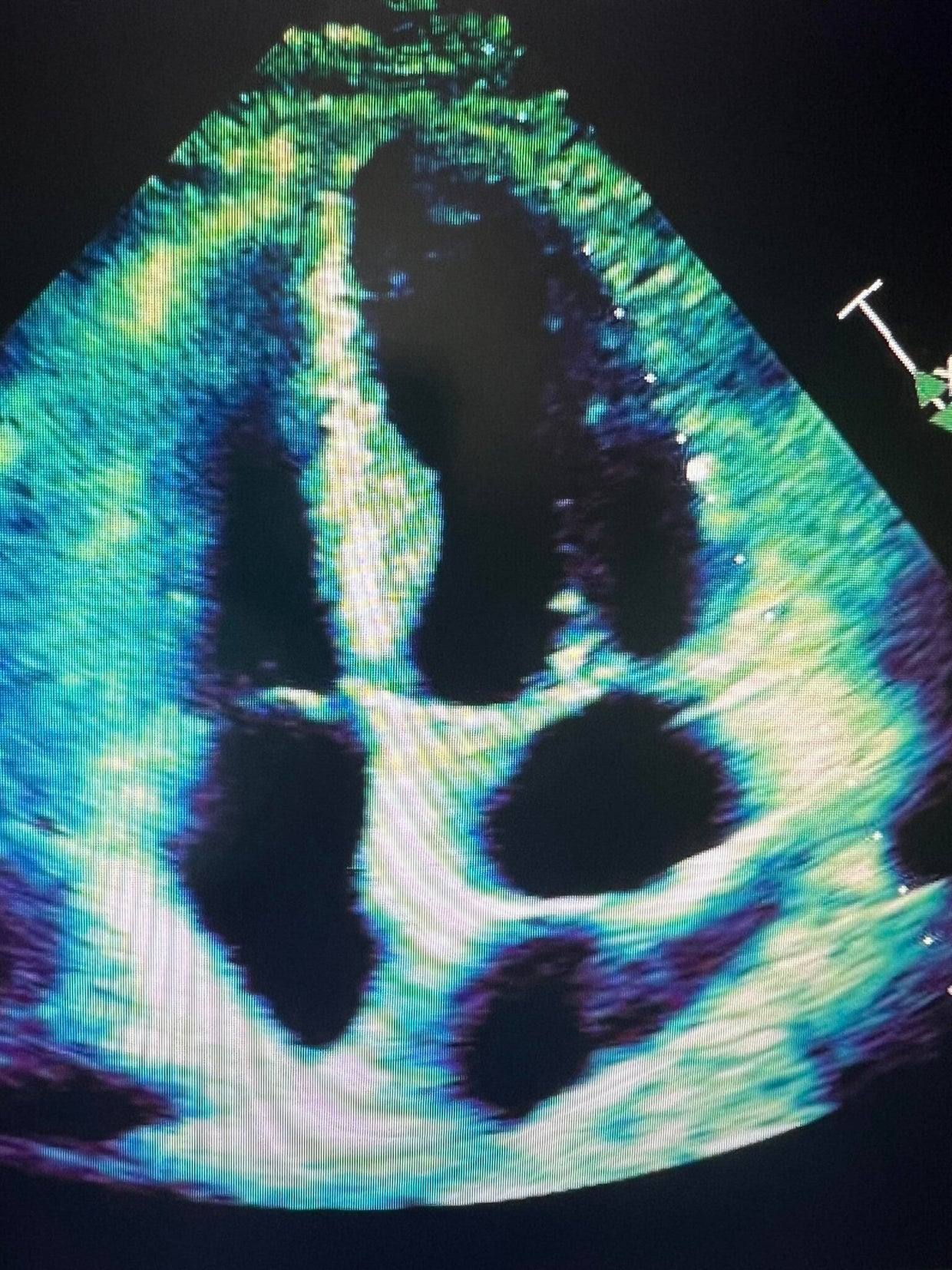
Perez had a rare congenital heart condition called cor triatriatum, where a membrane grows in one of the heart’s upper atria and splits it in two, leaving the heart with five chambers instead of the typical four. Without treatment, cor triatriatum can cause pulmonary hypertension, or high blood pressure in the arteries that carry blood from the heart to the lungs. That can eventually cause irregular heart rhythms, which can become life-threatening.
The condition is rare: About 0.8% of babies are born with a congenital heart disease, Dr. Wayne Franklin, a cardiologist and the senior vice president of the Heart and Lung Center at Children’s National Hospital, said. Cor triatriatum accounts for 0.1% of those cases, or about 1 in 10,000.
Perez’s case was even rarer. Cor triatriatum is almost always diagnosed in utero or infancy, and treated early in a person’s life. If it isn’t, it’s usually found when a person is in their 30s or 40s, Franklin said.
“Most patients with this condition don’t really survive this long,” said Dr. Tom Nguyen, the chief medical executive of the Baptist Health Miami Cardiac & Vascular Institute. “Carlos was very lucky to have lived this long before he started having triggers that something was wrong.”
What saved Perez, Nguyen said, was the presence of a small gap in the membrane. That had allowed blood to move through his heart somewhat normally. But it had narrowed as he aged, until the organ was under enough stress that it started exhibiting atrial fibrillation.
“If he didn’t have that, he certainly wouldn’t be here today,” Nguyen said.
Catching the condition was only the first step. Now, doctors had to treat it. First, Perez’s cardiologist tried medication. But in September, Perez had another episode and went back to the ER. Doctors had to shock his heart back into its normal rhythm. It became clear he would need surgery.
Now, Nguyen and cardiac surgeon Dr. Makoto Hashimoto had to operate on a heart unlike any they had ever seen. Nothing like the membrane exists in adult hearts. Hashimoto said he didn’t know which material was safe to remove and what could stay.
For help, Nguyen and Hashimoto turned to Dr. David Kalfa, the chief of cardiovascular surgery and co-director at Nicklaus Children’s Hospital’s Heart Institute. The three doctors are all faculty and researchers at the Florida International University Herbert Wertheim College of Medicine. Kalfa, who had treated cor triatriatum in pediatric patients, was able to give guidance on how to remove the membrane.
Then, the trio took it a step further. In infants, cor triatriatum is typically treated with open-heart surgery. But Hashimoto, the director of robotic cardiac surgery at FIU, and Nguyen, the director of minimally invasive surgery at Baptist Health Miami Cardiac & Vascular Institute, wanted to try a less invasive robotic operation.

“When they said they were going to have to cut a piece of my heart off, I’m imagining, you know, the full procedure,” said Perez, mimicking having his chest cut open. “When they said, ‘No, we don’t have to do that, we think we can do this,’ I felt like I was in great hands.”
Perez underwent surgery on Jan. 7, 2026. With guidance from Kalfa, Nguyen and Hashimoto were able to remove the membrane robotically. Robotic surgery allows doctors to magnify the operating field by up to 10 times, Nguyen said, making it even easier to identify what needed to be removed and what could stay.
Perez was left with just a few small incisions. He said the procedure was “like science fiction.” He was discharged from the hospital after less than a week. Today, he has just a few small scars and is back to his active lifestyle.
“He did fantastic,” Nguyen said. “It’s kind of a Cinderella story, of him being in the right place at the right time to have this condition taken care of.”
Perez will have to watch out for the signs of atrial fibrillation for the rest of his life, but as of now it can be managed with monitoring and medication. His cor triatriatum can be considered cured, Kalfa said.
The collaboration between Kalfa, Nguyen and Hashimoto hasn’t ended with Perez’s recovery.
All three doctors worked together again to conduct a robotic cardiac surgery at Nicklaus Children’s Hospital’s Heart Institute in August. It was the first surgery of its kind in Florida, Kalfa said. The procedure treated a congenital heart defect in a teenage boy, a hospital spokesperson said. The teen was able to go home one day after the operation.
The hospital has also developed a pediatric robotic cardiac program, Kalfa said. It’s only the second such program in the U.S.
“This pediatric knowledge helped an adult patient, then goes back to the pediatric population to help other kids by offering that robotic approach initially designed for the adult population,” Kalfa said. “It’s kind of beautiful.”
Edited by
Nicole Brown Chau