
The topic The AI start-ups fixing India’s broken roads and messy land records is drawing steady attention: readers, analysts, and industry watchers are all tracking how the story may unfold in the days ahead.
This is taking place in a fast-moving context — product cycles, platform shifts, and competitive moves can reshape the outlook quickly, so the details below are worth a careful read.
What follows is a clear walkthrough of the main facts and angles you need to make sense of the news.
At least half a dozen Indian start-ups are using AI to map and report road damage to authorities
In 2020, Sanjay Mandava flew down from Chicago to Chennai in southern India to resolve a personal land dispute.
Over the next few months, he was running around between government offices to access a dozen records that would conclusively prove that the property belonged to his family.
Just a sale deed dating back to when his parents bought the land was not enough. Authorities asked him to produce a string of other documents.
Frustrated by the experience, he built Landeed – an AI-led digital platform that enables users to aggregate fragmented, multi-source land-records, verify titles and conduct legal checks at the click of a few buttons, across 24 states in India.
“In the US or UK, when you purchase a property, the government verifies ownership. In India by contrast, we follow presumptive titling – the buyer is responsible for establishing ownership. A sale deed merely records the transaction – multiple other documents may be needed to prove title,” Mandava told the BBC.
These include building certificates, property tax receipts and land survey maps among others.
The system is rife for misuse – property disputes account for a bulk of civil litigation cases in the country where some 80% of household wealth is held in real estate.
Landeed has mapped large swathes of India using geo-spatial technologies and data from state land revenue departments, registration offices, survey records and municipal databases.
Using this, it has linked registered properties to their official land identification and survey numbers and ownership records.
An additional AI-layer can read these titles, extract information and spot inconsistencies within minutes – a process that takes lawyers and brokers several days.

With the largest repository of title data in the country, consisting of 1.8 billion documents, the app is now used by millions of individual and enterprise customers while doing real estate transactions.
India’s AI revolution is happening in data centre infrastructure and consumer applications rather than in research
The app is among a burgeoning list of Indian start-ups trying to address some of India’s most complex challenges in sectors ranging from legal-tech to healthcare, infrastructure, education and agriculture using AI.
Unlike the US and China which have a global dominance in building frontier language models like ChatGPT, India’s AI revolution is happening downstream in data centre infrastructure and consumer applications rather than in research.
Start-ups are solving issues for everything from pothole detection to tribal language translation to assisting overworked public-health professionals with medical tasks – often working with highly fragmented, multilingual datasets in extremely cost sensitive industries.
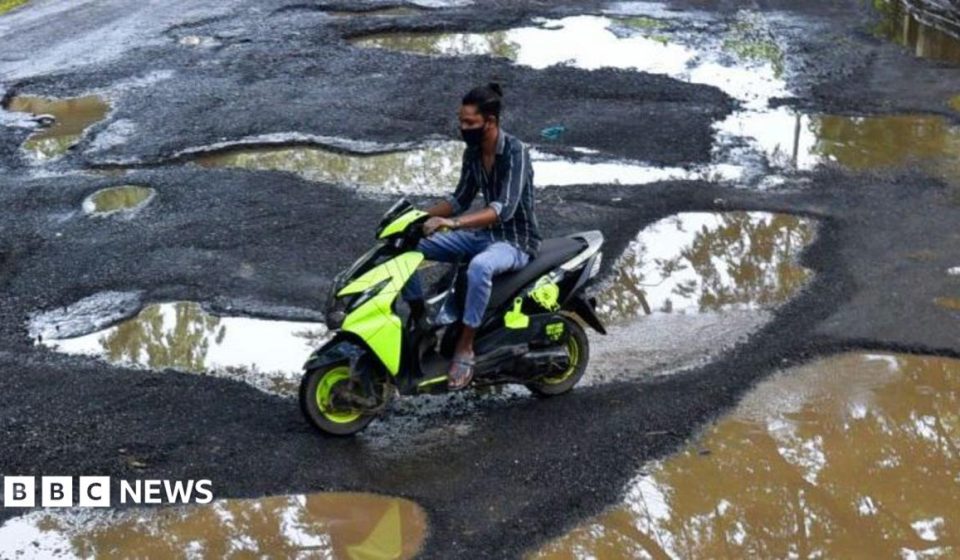
Bengaluru-based YouTube teacher Gaurav Sen’s AI app detects potholes using a dash-cam, satellite-based navigation and an AI vision model to analyse images.
It then identifies civic officials responsible for fixing them and sends them this data. He got viral attention recently given how widespread the menace of potholes is across India’s urban sprawls.
On last count, there are at least half a dozen other similar offerings that map and report road damage to authorities across the country.
“A municipal corporation can take the app and use it on public buses and taxis, to access real-time, updated data on road conditions,” Sen told the BBC.
In Mumbai on India’s western coast, Fractal Analytics – among the few Indian listed AI companies – has deployed its AI tool “Vaidya” in hospitals run by the local civic authority.
The app allows citizens to receive AI-generated, simplified summaries of their lab reports in multiple languages, identify nearby healthcare facilities based on their needs and gives doctors AI-guided pre-consultation support such as medical history and medication details of patients.
It also provides hospital administrators with a public health dashboard based on aggregated, anonymous insights from lab reports accessed through its tie-up with municipal hospitals, giving them crucial visibility into emerging infections or other disease trends.
This boom has led to a surge in funding for AI start-ups – up 265% year-on-year according to the data Inc42, external, a start-up information platform. They raised over $1bn in the first nine months of this year amid a relatively muted fundraising environment for the broader ecosystem.
Yet, these companies face an uphill task in commercialising their ideas and taking them beyond pilot.
“The cost of building in India is sometimes much higher than what Indian customers are willing to pay,” Fractal’s co-founder Srikanth Velamakanni told the BBC at his sprawling office overlooking Mumbai’s film city.
“The computing power needed to run an AI model is the same whether it is built in India or the US – but American customers have a far bigger paying capacity than those here.”
Indian AI founders are also being forced to build around scarcity, with availability of high quality chips at the right scale and price, a major impediment for many.
“I believe I am building one of the most impactful things for this country,” says Mandava.
“But I am starved for GPUs [chips that perform millions of calculations and help train AI models]. I have a hellish time trying to acquire them,” he says.
The country has promised its start-ups 38,000 GPUs through its government-led AI mission, external, but demand for this compute power is far greater than supply.
Fractal Analytics, a listed AI company has deployed its AI tool “Vaidya” in hospitals run by the Mumbai civic authority
Without these fundamental issues being addressed, there’s a risk that Indian AI companies will build shallow solutions that a next generation of founders will immediately make redundant, say experts.
“Someone like a Google will probably laugh if I tell them of my pilot. To make it sustainable and hard to replicate, it will have to be much more sophisticated,” says Sen, displaying a self-awareness of where his product currently stands.
From a lack of experienced talent to the struggle to turn successful pilots into recurring government contracts to heavy dependence on expensive foreign technologies, Indian founders are powering through many odds.
“We can still do it. We don’t want protection, but propel us, give us the weapons to compete against the best,” Mandava says, when asked what he wants from policymakers.
Follow BBC News India on Instagram, external, YouTube,, external X, external and Facebook, external.